

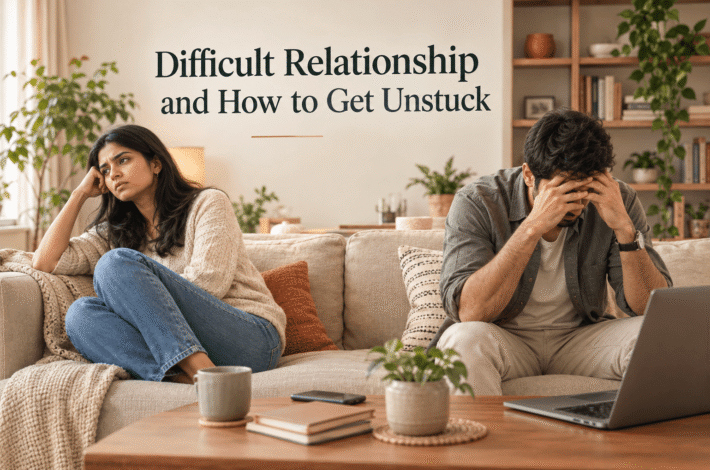
You keep having the same argument. You promise yourself that this time you will communicate differently, set a boundary, or finally walk away. Then something happens, emotions take over, and you find yourself back in the same place.
Maybe you still love the person. Maybe you are afraid of being alone. Or perhaps you keep wondering whether things could get better if you just tried a little harder.
When you are dealing with a difficult relationship, knowing what to do and actually doing it can feel like two completely different things. You may understand that something is not working, yet feel emotionally stuck between hope, fear, guilt, and attachment.
Getting unstuck does not always mean immediately ending a relationship. It means becoming honest about what is happening, understanding your role in the pattern, and making choices that support your emotional well-being.
Here is a practical step-by-step approach to help you move forward.
Sometimes, getting unstuck starts with being honest about what you need and what you can no longer ignore
Step 1: Acknowledge What Is Actually Happening
The first step in getting unstuck in a difficult relationship is to stop minimizing your experience.
Ask yourself what keeps happening, rather than focusing only on isolated good moments. Are you constantly walking on eggshells? Do your concerns get dismissed? Are you repeatedly having the same arguments without resolving anything? Do you feel unheard, controlled, criticized, or emotionally exhausted?
These can be signs of a difficult relationship that deserve your attention.
Try writing down specific situations instead of describing the relationship as simply “good” or “bad.” Look for patterns in your relationship problems. Patterns are often easier to recognize on paper than when you are caught inside an emotional situation.
Step 2: Identify the Pattern Keeping You Stuck
Many relationship struggles continue because the same cycle keeps repeating.
For example, imagine that your partner becomes distant. You become anxious and ask for reassurance. They feel pressured and withdraw further. You become more upset and try harder to get a response. Eventually, you argue, make up, and promise that things will change.
For a while, things feel better. Then the same situation happens again.
Neither person necessarily wakes up intending to create this cycle. But without awareness, unhealthy relationship patterns can become almost automatic.
Think about your own relationship. What usually triggers conflict? How do you respond? What does the other person do next? What happens afterward?
Understanding the cycle gives you something specific to work on instead of simply thinking, “We have relationship problems.”
Step 3: Separate What You Can Control From What You Cannot
One of the most important parts of learning how to get unstuck in a relationship is understanding the difference between responsibility and control.
You can control how you communicate, the boundaries you set, the choices you make, and whether you continue participating in a particular pattern.
You cannot control whether another person changes, communicates honestly, respects your boundaries, or takes responsibility for their actions.
This distinction can be uncomfortable, especially when you have spent a long time trying to fix relationship problems by changing yourself or trying harder.
Healthy relationship guidance does not ask you to carry the entire relationship on your shoulders. It helps you understand where your responsibility ends and another person’s begins.
Step 4: Get Clear About What You Need
Sometimes you feel stuck because you know what you dislike but have not identified what you actually need.
Take some quiet time and write down your non-negotiables.
You might need honest communication, emotional safety, respect, consistency, personal space, affection, or shared responsibility.
Then ask yourself whether these needs are being acknowledged in the relationship.
This is not about creating a perfect partner or expecting another person to meet every emotional need. It is about recognizing the basic conditions you need to feel respected and emotionally secure.
Clarity makes decisions easier because you are no longer reacting only to the latest argument.
Step 5: Stop Making Decisions Only From Fear
Fear can make a difficult relationship feel impossible to leave or impossible to change.
You may think about being alone, starting over, disappointing your family, losing shared memories, or regretting your decision later.
These fears are real, but they do not necessarily tell you what is right for you.
Instead of asking yourself only what you are afraid will happen, consider what happens if nothing changes.
If the relationship stayed exactly as it is for another year, how would you feel? What would your daily life look like? Would you feel more peaceful, or more drained?
These reflections can help you look beyond the temporary discomfort of making a difficult decision.
Step 6: Change One Pattern Instead of Trying to Fix Everything
When you are dealing with several relationship problems at once, trying to solve everything immediately can become overwhelming.
Choose one recurring issue.
Perhaps you always avoid difficult conversations until you are angry. Maybe you constantly seek reassurance instead of expressing what you need directly. Perhaps you agree to things you are uncomfortable with because you are afraid of conflict.
Work on one behavior at a time.
For example, instead of staying silent and becoming resentful, you might practice saying, “I am uncomfortable with this, and I need us to talk about it.”
Small changes can reveal whether the relationship has room for healthier communication.
Step 7: Give Yourself Space to Reflect
When emotions are intense, it can be difficult to see your situation clearly.
This is where relationship coaching can be useful. A coach can provide a neutral space where you can slow down, identify patterns, clarify your needs, and examine the choices available to you.
Life coaching and tarot can also work together in a grounded way.
Life coaching comes first. It focuses on your thoughts, behaviors, boundaries, communication, and practical decisions. Tarot can then be used as a reflective tool to help you explore questions you may be struggling to articulate.
A tarot reading does not need to tell you whether you should stay or leave. Instead, it can encourage you to reflect on what you are feeling, what you may be avoiding, and what perspective you may not have considered.
The goal is greater self-awareness, not handing your decisions over to a card.
Is Relationship Coaching or Tarot Really Going to Help
It is understandable to be skeptical.
You may wonder whether talking to a coach can actually change a difficult relationship, or whether tarot is simply superstition.
The important distinction is what you expect these tools to do.
Relationship coaching cannot make another person change. Tarot cannot predict every outcome or make decisions for you.
What they can do is create space for honest reflection. Coaching can help you turn confusion into practical steps, while tarot can provide another framework for looking at your emotions and circumstances.
You remain responsible for your choices.
Step 8: Decide What Moving Forward Means for You
Moving forward in a relationship does not always look the same for everyone.
For one person, it may mean rebuilding communication and creating healthier boundaries. For another, it may mean taking some distance and reassessing the relationship. For someone else, it may mean accepting that the relationship is no longer healthy and preparing to leave.
There is no single formula for every relationship.
What matters is whether your next step is based on clarity rather than panic, guilt, or pressure.
If there is abuse, intimidation, threats, coercive control, or fear for your safety, the priority is not relationship repair. Your safety comes first, and professional or local support may be necessary.
You Do Not Have to Figure It All Out at Once
Getting unstuck in a difficult relationship is rarely one dramatic decision. Often, it begins with a quieter realization that you cannot continue ignoring what you already know.
Start by noticing the pattern.
Then identify what you need.
Separate your responsibilities from someone else’s.
Set one clear boundary.
Have one honest conversation.
And permit yourself to consider a future that is not built around repeating the same relationship struggles.
You do not have to have every answer before taking the next healthy step.
If you are feeling confused, emotionally exhausted, or unsure about what to do next, Ananya Moon offers grounded relationship coaching and Life Coaching and Tarot sessions designed to help you reflect, gain clarity, and move forward with greater self-awareness.
You can book a session with Ananya Moon when you are ready to explore your situation in a supportive and judgment-free space.


