

Your child refuses to put away their toys, screams when you say no, or throws a tantrum in the middle of a busy day. You feel your patience slipping, and a small voice inside you asks, “Am I being too strict, or am I being too soft?”
If you have ever felt guilty after raising your voice or wondered whether saying no will hurt your child’s feelings, you are not alone. Parenting comes with love, but it also comes with exhaustion, frustration, and moments when you simply do not know what to do next.
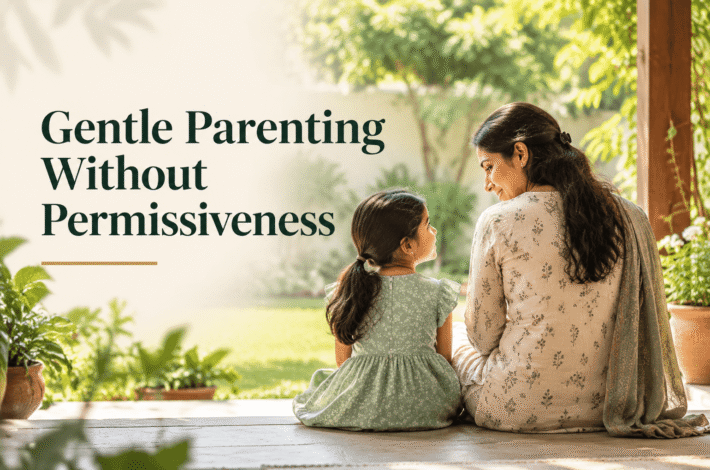
Gentle parenting is not about letting your child do whatever they want. It is about guiding their behaviour with empathy, consistency, and firm boundaries. You can respect your child’s feelings without agreeing with every demand. In fact, children need both your love and your guidance to feel secure.
Love does not mean removing every limit. Sometimes, the most loving thing you can do is hold a boundary with patience.
What Gentle Parenting Really Means
Gentle parenting focuses on understanding your child’s emotions while helping them learn responsibility. Instead of relying on fear, shouting, or punishment, you teach your child why certain behaviours are unacceptable and what they can do differently.
However, understanding your child’s feelings does not mean accepting every behaviour.
Your child can feel angry when you turn off the television, but that does not mean they can hit you. They can feel disappointed when you refuse to buy a toy, but that does not mean you must change your decision.
This is where gentle parenting with boundaries makes a difference. You acknowledge the emotion while remaining clear about the limit.
How to Set Boundaries With Children Without Losing the Connection
Setting limits can feel uncomfortable, especially when your child cries or tells you that you are being unfair. But boundaries are not a rejection of your child’s feelings. They help your child understand what is safe, respectful, and acceptable.
1. Acknowledge Feelings Without Giving In
When your child becomes upset, try to understand what they are feeling before correcting their behaviour.
For example, instead of saying, “Stop crying. You are making a big deal out of nothing,” you could say, “I know you really wanted to keep playing, and stopping feels upsetting. But it is bedtime now.”
You are not dismissing their disappointment, and you are not changing the rule. You are showing them that their feelings matter, even when the answer remains no.
2. Be Consistent With Your Boundaries
If bedtime changes every time your child protests, they may struggle to understand which limits are firm.
Choose a few important family rules and communicate them clearly. Follow through calmly and consistently, even when your child tests those limits.
Firm boundaries in parenting do not require a harsh voice. Sometimes, the most loving thing you can do is calmly repeat your decision without getting pulled into an argument.
3. Use Natural Consequences Instead of Fear
Gentle parenting discipline is about teaching, not making your child feel ashamed.
If your child throws their crayons, you can explain that crayons are for drawing, not throwing, and put them away temporarily if the behaviour continues. If they make a mess, involve them in cleaning it up when appropriate.
These positive parenting techniques help children understand that actions have consequences while preserving their sense of dignity.
4. Repair the Relationship After Difficult Moments
You will not always respond perfectly. You may raise your voice after a tiring day or react more strongly than you intended.
When that happens, take responsibility. You might say, “I was frustrated, but I should not have shouted. I am sorry. We still need to follow the rule, and next time I will try to speak more calmly.”
An apology does not weaken your authority. It teaches your child that accountability applies to everyone, including adults.
A Small Parenting Moment That Can Change Everything
Imagine your eight-year-old refuses to finish their homework because they want to play a video game.
You could shout, threaten to take everything away, or give in because you cannot handle another argument.
Instead, take a breath and say, “I understand that you want to play. Homework needs to be finished before gaming. Would you like to start with the easiest question or take a five-minute break first?”
Your child may still complain. Gentle parenting without permissiveness does not guarantee that every boundary will be accepted happily.
What changes is how you respond. You offer choices within a clear limit, helping your child develop independence without handing over responsibility.
Is Gentle Parenting Too Soft to Actually Work
You may worry that respectful parenting strategies will make your child demanding or unable to handle disappointment. But gentleness and permissiveness are not the same.
Children can experience frustration while still feeling loved and supported. The goal is not to prevent every difficult emotion. It is to help your child gradually learn how to manage those emotions and make better choices.
Progress may take time, and your approach will need to change as your child grows. If family conflicts feel overwhelming, Parenting Coaching or Parent-Child Relationship Counseling can help you identify patterns, communicate more effectively, and build practical strategies that suit your family.
Finding Clarity Through Life Coaching and Tarot
Sometimes, the hardest part of parenting is not knowing what to do. It is managing your own guilt, childhood experiences, fear of being judged, or worry that you might repeat patterns you experienced growing up.
Life coaching can help you recognise these patterns, understand your emotional triggers, and build a calmer, more confident approach to parenting. You begin to respond with intention instead of reacting from exhaustion or fear.
With Ananya Moon, led by Manishaa, tarot can complement this process as a reflective tool for exploring emotions, recurring patterns, and possible perspectives. It does not replace practical parenting guidance or guarantee answers, but it can support personal reflection alongside life coaching.
You do not need to become a perfect parent. Your child needs a parent who is willing to learn, set loving limits, and keep showing up, even after difficult days.
Take the First Step Towards a More Connected Relationship
If you are tired of the cycle of shouting, guilt, and second-guessing yourself, you deserve support too. You can learn to hold boundaries without feeling cruel and offer comfort without giving up your values.
Book a session with Ananya Moon to explore your challenges, gain clarity, and work towards a healthier relationship with yourself and your child. You do not have to figure everything out alone.


